Author: tl8088r7lolo

  • psbp

    Your Browsing Homepage (formerly Primo Startup Browsing Page)

    A start/home page for your favorite websites.

    Why?

    • Free and open-source.
    • Local and offline.
    • No hidden scripts.
    • Shortcut for your favorite websites, meaning your favorite and most used websites in one page.
    • Native/Pure JavaScript.
    • Files to edit/manage your favorite websites.
    • One file to add a new website.
    • Easy to customize.
    • Dark & Light mode.
    • Multiple search engines.
    • Multiple custom versions.

    Live Preview

    https://m-primo.github.io/psbp/index.html

    Google Chrome Extension

    NOT UP-TO-DATE

    https://chrome.google.com/webstore/detail/your-browsing-homepage/gankljibcichebamdgagnnncmnoacdmi

    Mozilla Firefox Extension

    NOT UP-TO-DATE

    https://addons.mozilla.org/en-US/firefox/addon/your-browsing-homepage/

    Usage

    Add Sites

    Open userSites.js, then add a code like the syntax bellow:

    new Site("Website Name", "full url with http or https", "iconname.ext", "Description (you can leave it empty)");

    For example, if you want to add Blogger:

    new Site("Blogger", "https://blogger.com", "b.png");

    DO NOT FORGET TO ADD THE IMAGE IN THIS DIRECTORY: img/site.

    To add an external icon, just add true at the end:

    For example:

    new Site("Website Name", "full url with http or https", "http://www.example.com/iconname.ext", "Description (you can leave it empty)", true);

    Just replace http://www.example.com/iconname.ext with the actual image url.

    Add Versions

    First: Create your userSites script file, and the name should be like this: version_userSites.js.

    For example, if you want to name your version personal, so the script file name should be: personal_userSites.js.

    Second: Add the websites you want in that newly created file, just like in userSites.js.

    Finally: To access the homepage with your created version, you should add ?version=version in the URL bar.

    For the above example, you should add ?version=personal in the URL bar, and it’ll load your websites you added in personal_userSites.js file. In other words, if your version is personal and the current homepage link is https://example.com, you can access it like this: https://example.com?version=personal.

    Changelog

    Changelog

    Contributing

    Pull requests are welcome. For major changes, please open an issue first to discuss what you would like to change.
    License

    MIT

    License Details

    Visit original content creator repository

  • BigDataAnalysis-RecommenderForAmazon

    Big Data Analysis and Recommdender System for Amazon

    Problem Statement:

    Perform Data Analysis on 130M+ records and build a recommender system.

    Deployed single node cluster to perform analysis using map reduce

    Carried out data analysis on big data.

    /**

    author Sayali Walke

    **/

    Dataset used for analysis:

    The Amazon Customer Reviews Dataset is a large dataset with size > 20GB.
    However, for this analysis, I’ve used a subset of this dataset named
    “amazon_reviews_us_Beauty_v1_00.tsv”

    Here’s the detailed description of dataset and its contents.

    marketplace: 2 letter country code of the marketplace where the review was written.

    customer_id: Random identifier that can be used to aggregate reviews written by a single author.

    review_id: The unique ID of the review.

    product_id: The unique Product ID the review pertains to. In the multilingual dataset the reviews for the same product in different countries can be grouped by the same product_id.

    product_parent: Random identifier that can be used to aggregate reviews for the same product.

    product_title: Title of the product.

    product_category: Broad product category that can be used to group reviews
    (also used to group the dataset into coherent parts).

    star_rating: The 1-5 star rating of the review.

    helpful_votes: Number of helpful votes.

    total_votes: Number of total votes the review received.

    Vine: Review was written as part of the Vine program.

    verified_purchase: The review is on a verified purchase.

    review_headline: The title of the review.

    review_body: The review text.

    review_date: The date the review was written.

    Apache MAHOUT

    Created a recommender system using Mahout. It serves the functionality of recommending similar products based on the similar items bought by other customers.(People who bought this….also bought this…..)

    Hadoop

    I have created a single node Hadoop cluster on virtual machine and carried out following data analysis

    using various Map-reduce Algorithms:

    1. Top 100 Products based on average of reviews: (Filtering Pattern )

    2. Average chaining and Sorting Of reviews: (Chaining and Sorting )

    3. No of reviews per product: (Numerical Summarization)

    4. Inner join on Average of reviews and no of reviews for each product(Inner Join)

    5. Customer list for each product: (Inverted Index)

    6. Created 5 bins for 1,2,3,4,5 ratings: Binning (Organization Pattern)

    7. Partitioned the data into different files for each day in 2015-08: Partitioning (Organization Pattern)

    8. Distinct Reviews Counter: (Numerical Summarization Pattern)

    9. Percentage of Helpful votes: (Numerical Summarization Pattern)

    Apache HIVE

    1. Top 10 Products based on Average ratings

    2. Most Valuable Customer based on number of products bought

    3. Most popular product based on number times product bought

    4. Number of products bought per day

    5. Number of products per ratings

    Apache Pig

    1. Number of reviews given per day.

    2. Number reviews given per product.

    Visit original content creator repository

  • supabase-graphql-example

    Supabase GraphQL Example

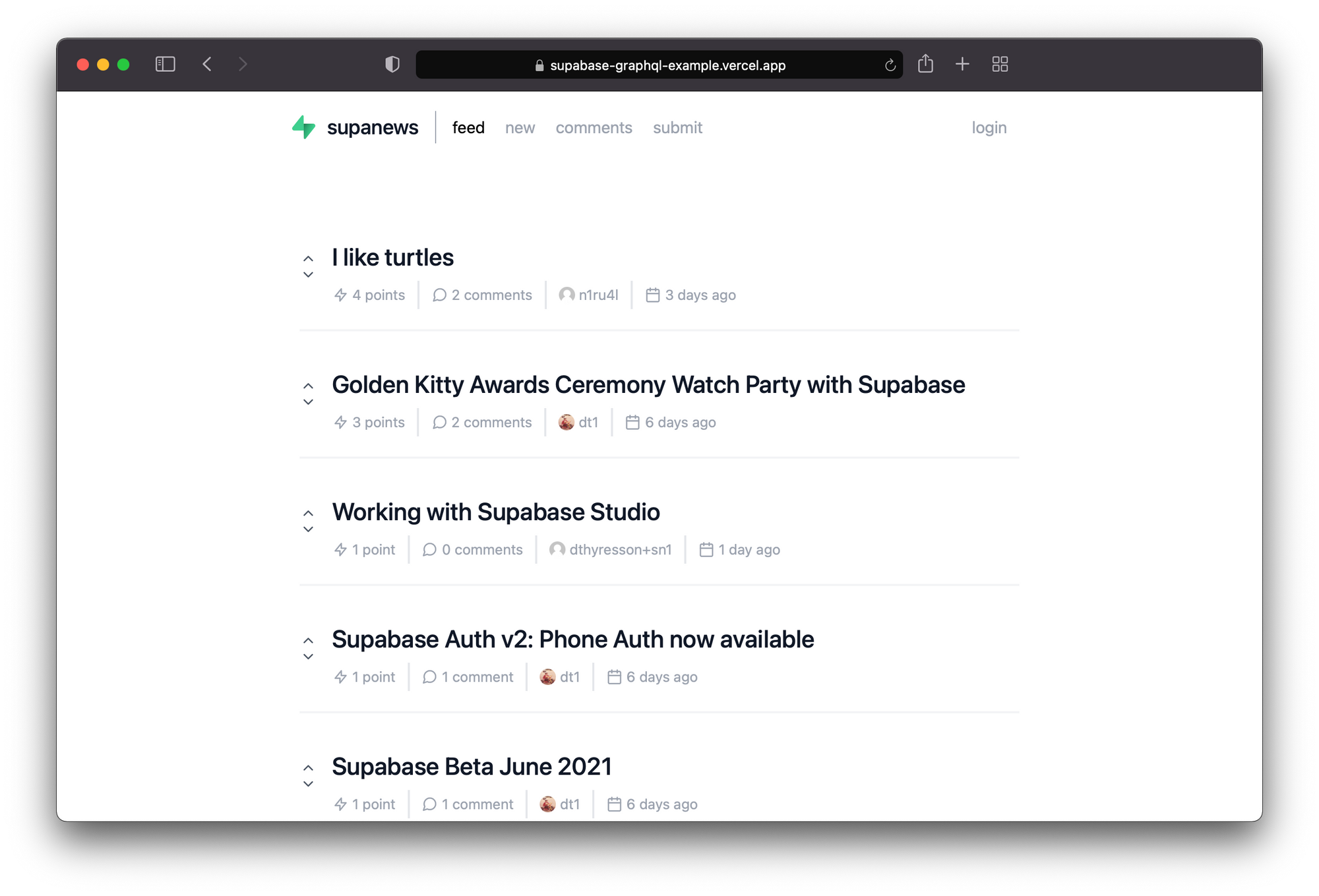
    A basic HackerNews-like clone where posts can be submitted with url links and then up and down voted.

    graphql-hn

    Showcase

    Backend

    • CRUD (Query + Mutation Operations)
    • Cursor Based Pagination
    • Authorization / Postgres Row Level Security
    • Supabase – Create a backend in less than 2 minutes. Start your project with a Postgres Database, Authentication, instant APIs, Realtime subscriptions and Storage.
    • pg_graphql – A native PostgreSQL extension adding GraphQL support. The extension keeps schema generation, query parsing, and resolvers all neatly contained on your database server requiring no external services.
    • Postgres Triggers and Postgres Functions – When votes are in, use triggers to invoke a Postgres function that calculates a post score to rank the feed
    • Postgres Enumerated Types – Enums help defined the direction of a vote: UP or DOWN.

    Frontend

    • Next.js – React Framework
    • TypeScript – TypeScript is a strongly typed programming language that builds on JavaScript, giving you better tooling at any scale.
    • graphql-code-generator – Generate code from your GraphQL schema and operations with a simple CLI
    • gql-tag-operations-preset – This code gen preset generates typings for your inline gql function usages, without having to manually specify import statements for the documents
    • urql – A highly customizable and versatile GraphQL client
    • Gravatar – Default avatar profile images from Gravatar

    Functionality

    • Registration
    • Get a ranked feed of posts
    • Create Post
    • Delete Post
    • Create Comment
    • Delete Comment
    • Upvote/Downvote Post
    • View Profile (Account)
    • View Profile (Public)
    • Pagination (Posts, Comments)

    QuickStart

    Setup env vars

    Install dependencies, GraphQL codegen, run app

    yarn
    yarn codegen
    yarn workspace app dev

    Deploy to Vercel

    Provide the following settings to deploy a production build to Vercel:

    • BUILD COMMAND: yarn codegen && yarn workspace app build
    • OUTPUT DIRECTORY: ./app/.next
    • INSTALL COMMAND: yarn
    • DEVELOPMENT COMMAND: yarn codegen && yarn workspace app dev --port $PORT

    Development

    1. Fetch latest GraphQL Schema
    yarn codegen:fetch
    1. Generate Types and Watch for Changes
    yarn codegen:watch
    1. Run server
    yarn workspace app dev

    Synchronize the GraphQL schema

    Note: You need to call select graphql.rebuild_schema() manually to synchronize the GraphQL schema with the SQL schema after altering the SQL schema.

    Manage Schema with dbmate

    1. brew install dbmate
    2. Setup .env with DATABASE_URL
    3. Dump Schema
    cd data
    dbmate dump
    

    Note: If pgdump fails due to row locks, a workaround is to grant the postgres role superuser permissions with ALTER USER postgres WITH SUPERUSER. After dumping the schema, you should reset the permissions using ALTER USER postgres WITH NOSUPERUSER. You can run these statements in the Superbase Dashboard SQL Editors.

    Schema (Public)

    • Profile belongs to auth.users

    • Post

    • Comment belongs to Post and Profile

    • Vote belongs to Post (can have a direction of UP/DOWN)

    • direction enum is “UP” or “DOWN”

    Constraints

    • Post url is unique
    • Vote is unique per Profile, Post (ie, you cannot vote more than once — up or down)

    See: ./data/db/schema.sql

    Note: The schema includes the entire Supabase schema with auth, storage, functions, etc.

    Seed Data

    A data file for all Supabase Blog posts from the RSS feed can be found in ./data/seed/blog_posts.csv and can be loaded. Another file for comments is available as well.

    Note: Assumes a known profileId currently.

    GraphQL Schema

    See: ./graphql/schema/schema.graphql

    Example Query

    See: ./graphql/queries/

    Use: https://mvrfvzcivgabojxddwtk.supabase.co/graphql/v1

    Note: Needs headers

    
    Content-Type: application/json
    apiKey: <supabase_anon_key>


    GraphiQL

    GraphiQL is an in-browser IDE for writing, validating, and testing GraphQL queries.

    Visit http://localhost:3000/api/graphiql for the Yoga GraphiQL Playground where you can experiment with queries and mutations.

    Note: Needs headers

    
    Content-Type: application/json
    apiKey: <supabase_anon_key>


    Note: In order for the RLS policies authenticate you, you have to pass an authorization header (see example):

    authorization: Bearer <access_token>


    Ranked Feed

    query {
      rankedFeed: postCollection(orderBy: [{ voteRank: AscNullsFirst }]) {
        edges {
          post: node {
            id
            title
            url
            upVoteTotal
            downVoteTotal
            voteTotal
            voteDelta
            score
            voteRank
            comments: commentCollection {
              edges {
                node {
                  id
                  message
                  profile {
                    id
                    username
                    avatarUrl
                  }
                }
              }
              commentCount: totalCount
            }
          }
        }
      }
    }

    Row Level Security Matrix (RLS)

    You can query all policies via: select * from pg_policies.

    See: Row Level Security Matrix (RLS)

    Read More

    Troubleshooting

    1. dbmate can create schema_migrations tables in schemas. To make sure they are not included in your GraphQL Schema:
    revoke select on table public.schema_migrations from anon, authenticated;
    1. To enable inflection
    comment on schema public is e'@graphql({"inflect_names": true})';
    1. Try the heartbeat to see if pg_graphql can access requests
    select graphql_public.graphql(
    	null,
    	$$ { heartbeat }$$
    )
    

    Returns:

    { "data": { "heartbeat": "2022-07-28T17:07:07.90513" } }
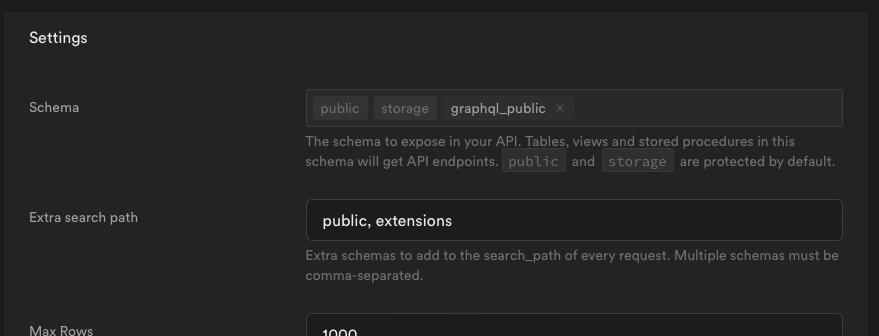
    1. Is the public_graphql schema not exposed properly?

    Getting an 406 status or error message like:

    {
        "message": "The schema must be one of the following: public, storage"
    }
    

    Then be sure to expose the graphql_public in Settings > Project settings > API.

    The schema to expose in your API. Tables, views and stored procedures in this schema will get API endpoints.

    image

    Visit original content creator repository
  • Geospatial-Analysis

    Geospatial-Analysis

    Objective

    The basic idea of analyzing the Zomato dataset is to get a fair idea about the factors affecting the establishment of different types of restaurants at different places in Bengaluru. This Zomato data aims at analyzing demography of the location. Most importantly it will help new restaurants in deciding their theme, menus, cuisine, cost, etc for a particular location. It also aims at finding similarity between neighborhoods of Bengaluru on the basis of food.

    Problem Statement

    Observations on the following are made:

    1. Top restaurant chains in Bangaluru
    2. How does the price differ between restaurants that accept online orders and those that don’t?
    3. How many restaurants offer table reservations compared to those that do not?
    4. Types of restaurants available
    5. Top-rated restaurants
    6. Restaurants located at various locations around Bangalore
    7. Approximate cost for 2 people
    8. How does the vote on restaurants accepting online orders compare to those refusing to accept them?
    9. In what restaurant does the most costly rate for two people exist? What is the dish involved? The most popular dish to eat there?
    10. Top ten most expensive and cheapest restaurants, based on an estimate for two people
    11. Restaurants under 500 (budget hotels)
    12. Budget-friendly restaurants with rating >4
    13. Overall number of restaurants that have ratings >4 and are under budget (less than 500)
    14. Hotels at various locations with affordable rates
    15. Foodie’s hotspots
    16. Heatmap of North Indian and South Indian restaurants
    17. Chains with the most popularity for casual dining
    18. Favorite dishes in various cuisines represented by a word cloud

    Dataset

    The dataset contains 17 columns as shown below:

    • url – url of the restaurant in the zomato website
    • address – address of the restaurant in Bengaluru
    • name – name of the restaurant
    • online_order – whether online ordering is available in the restaurant or not
    • book_table – table booking option available or not
    • rate – overall rating of the restaurant out of 5
    • votes – total number of rating for the restaurant as of the above mentioned date
    • phone – phone number of the restaurant
    • location – neighborhood in which the restaurant is located
    • rest_type – restaurant type
    • dish_liked – dishes people liked in the restaurant
    • cuisines – food styles, separated by comma
    • approx_cost(for two people) – approximate cost of meal for two people
    • reviews_list – list of tuples containing reviews for the restaurant
    • menu_item – list of menus available in the restaurant
    • listed_in(type) – type of meal
    • listed_in(city) – neighborhood in which the restaurant is listed

    Data Analysis Using Python

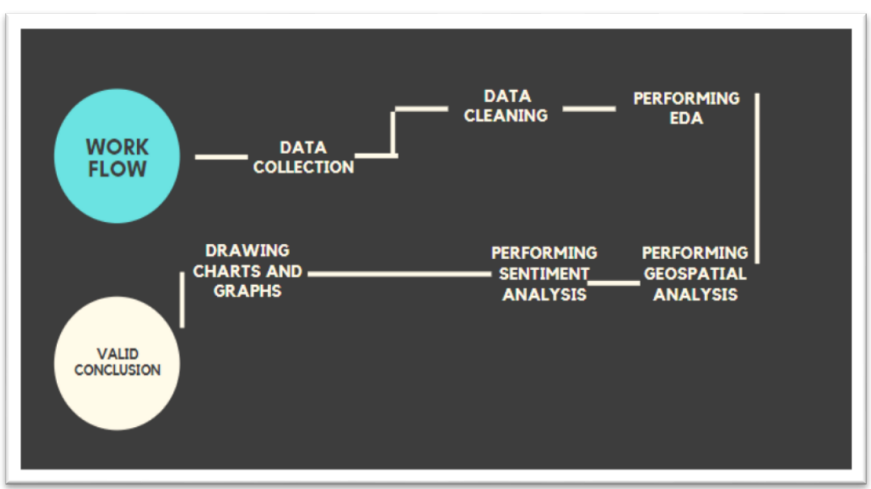
    Work flow of process:

    1. Data Collection
    2. Data Cleaning
    3. Performing EDA
    4. Performing Geospatial Analysis
    5. Performing Sentiment Analysis

    image

    Data Collection

    • The Dataset “ZOMATO BANGALORE RESTAURANTS” is publicly available on Kaggle website with 51,717 records and 17 attributes as shown under the dataset section.

    Data Cleaning

    • This is an essential step to perform before creating a visualization.
    • Clean, consistent data will be much easier to visualize.
    • As a result, missing values are filled, data are filtered accordingly, and inappropriate data are removed.

    Exploratory Data Analysis

    • There are different types of charts Bar, Pie, Line, Scatter Plot, Column chart etc. which can visually present the data in a more understandable way.
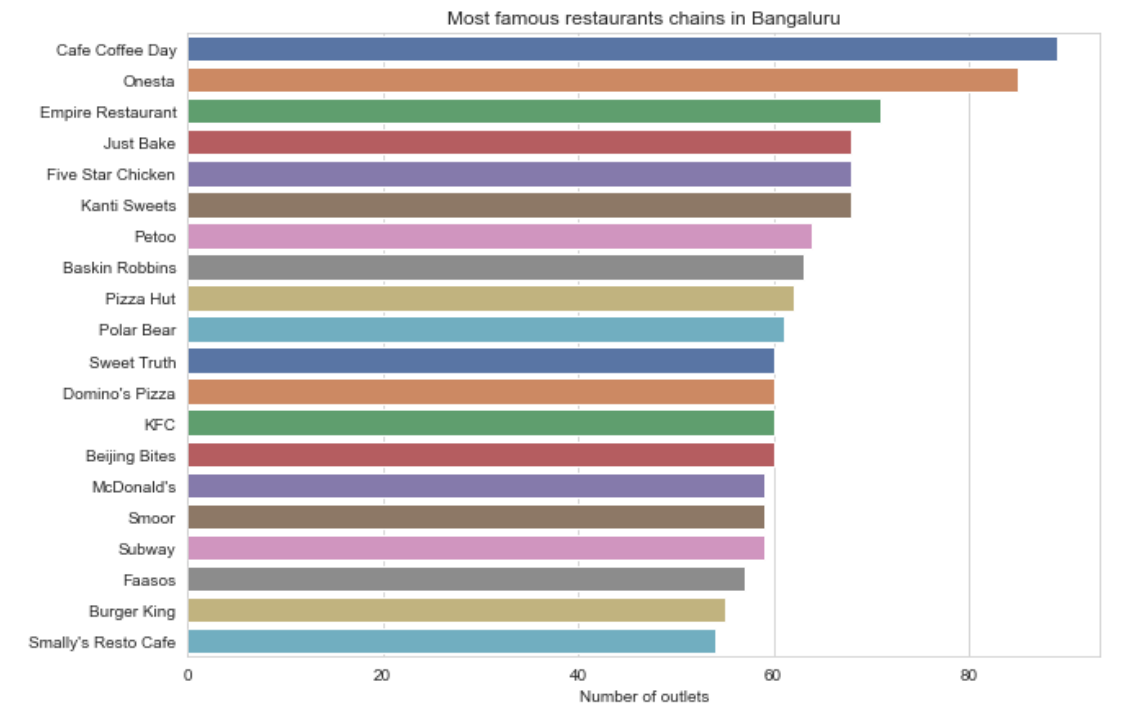
    • Below bar chart shows the most famous restaurant chains in Bangalore with number of outlets.

    image

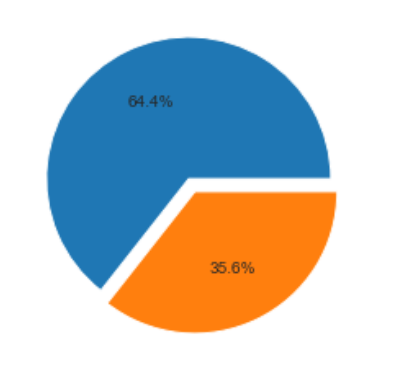
    • The following pie chart shows the percentage of online orders accepted by restaurants.

    image

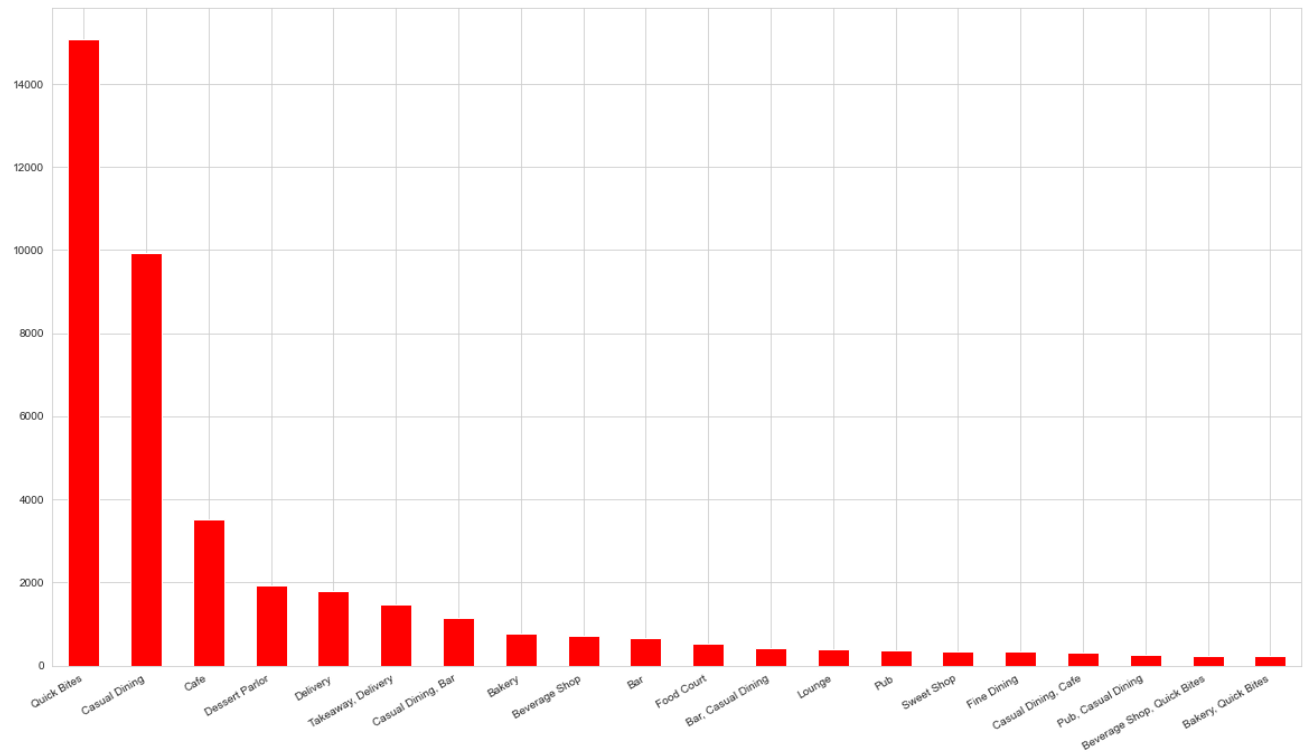
    • The below figure represents the bar chart for different types of restaurants.

    image

    • Bar graph of different varieties of cuisines in Bangalore.

    image

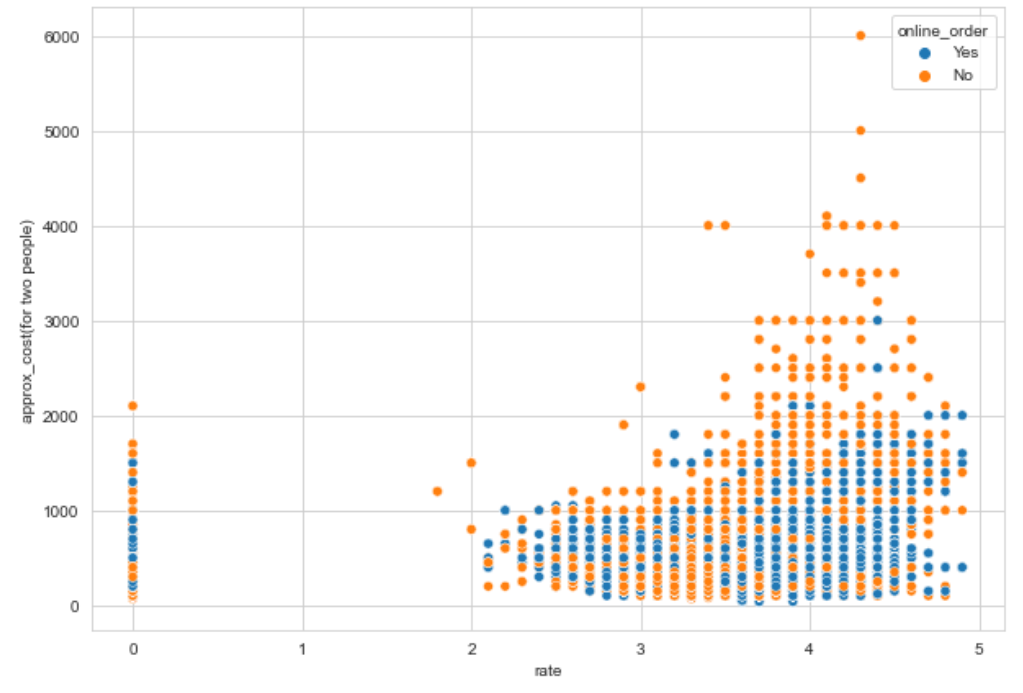
    • Below scatter plot with X axis denotes the ratings of the restaurants and Y axis denotes the approximate cost for 2 people.

    image

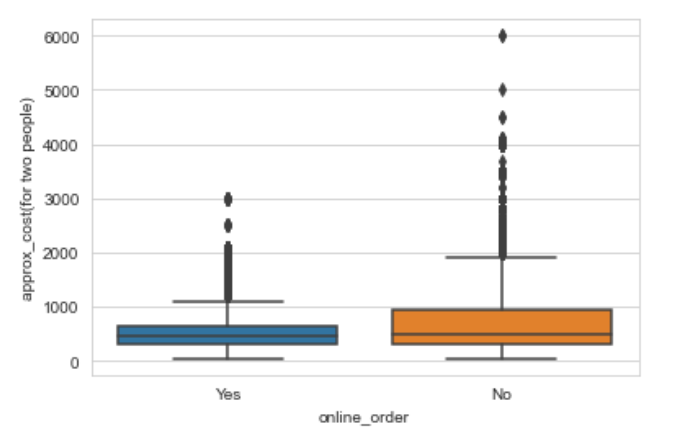
    • Box plot depicting the price difference between restaurants that accept online orders and those that do not

    image

    Geospatial Analysis

    • Geospatial Analysis is useful for locating the geographical area in a particular region.

    Heatmap of Restaurants in Bengaluru city

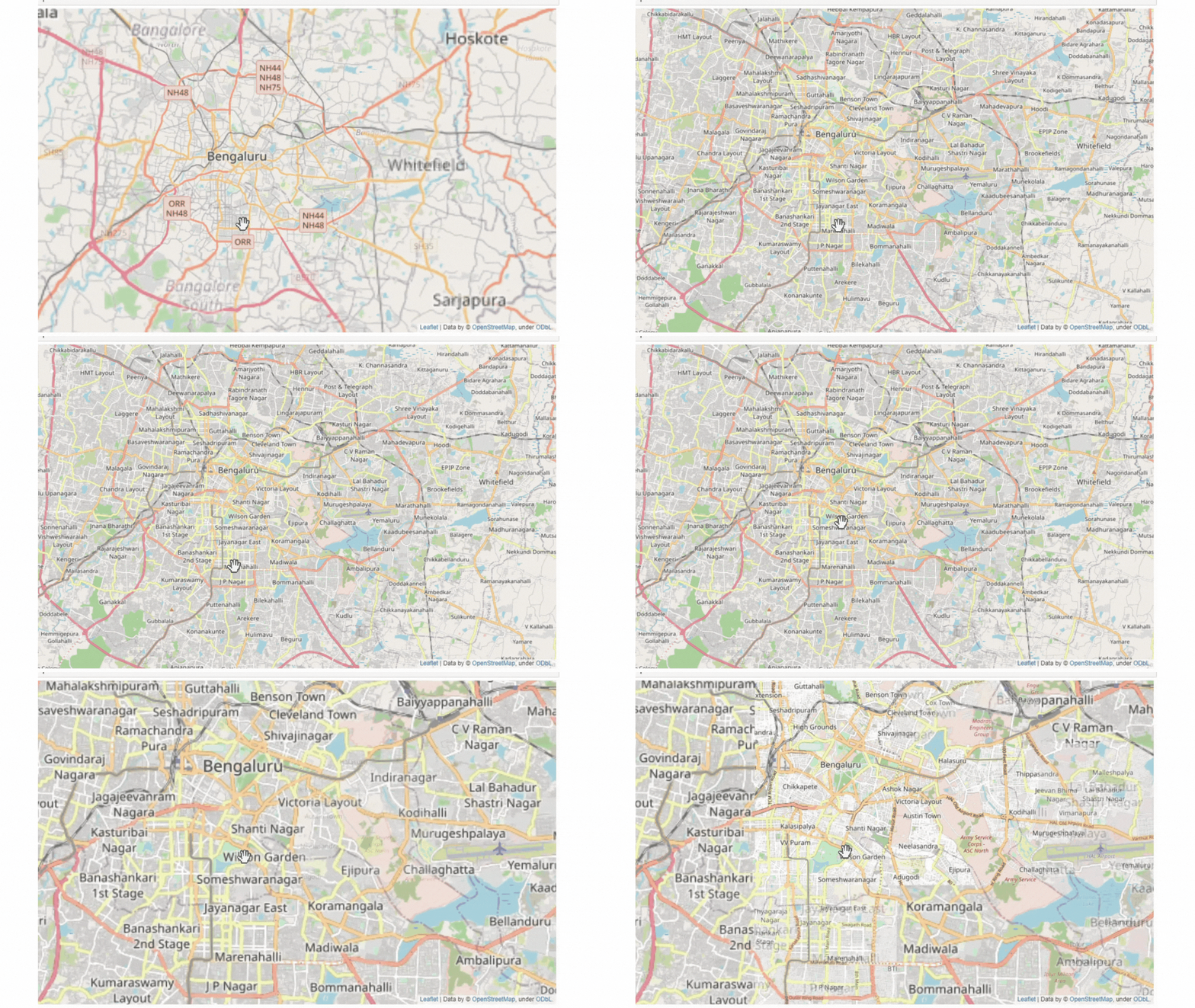
    • For locating the restaurants in geographical map, we need latitudes, longitudes and count of restaurants.
    • Extract the “Latitude” and “Longitude” w.r.t. different Locations using Python’s Geopy library.
    • Generate a “BaseMap” of Bangalore using Python’s Folium library.

    geo analysis

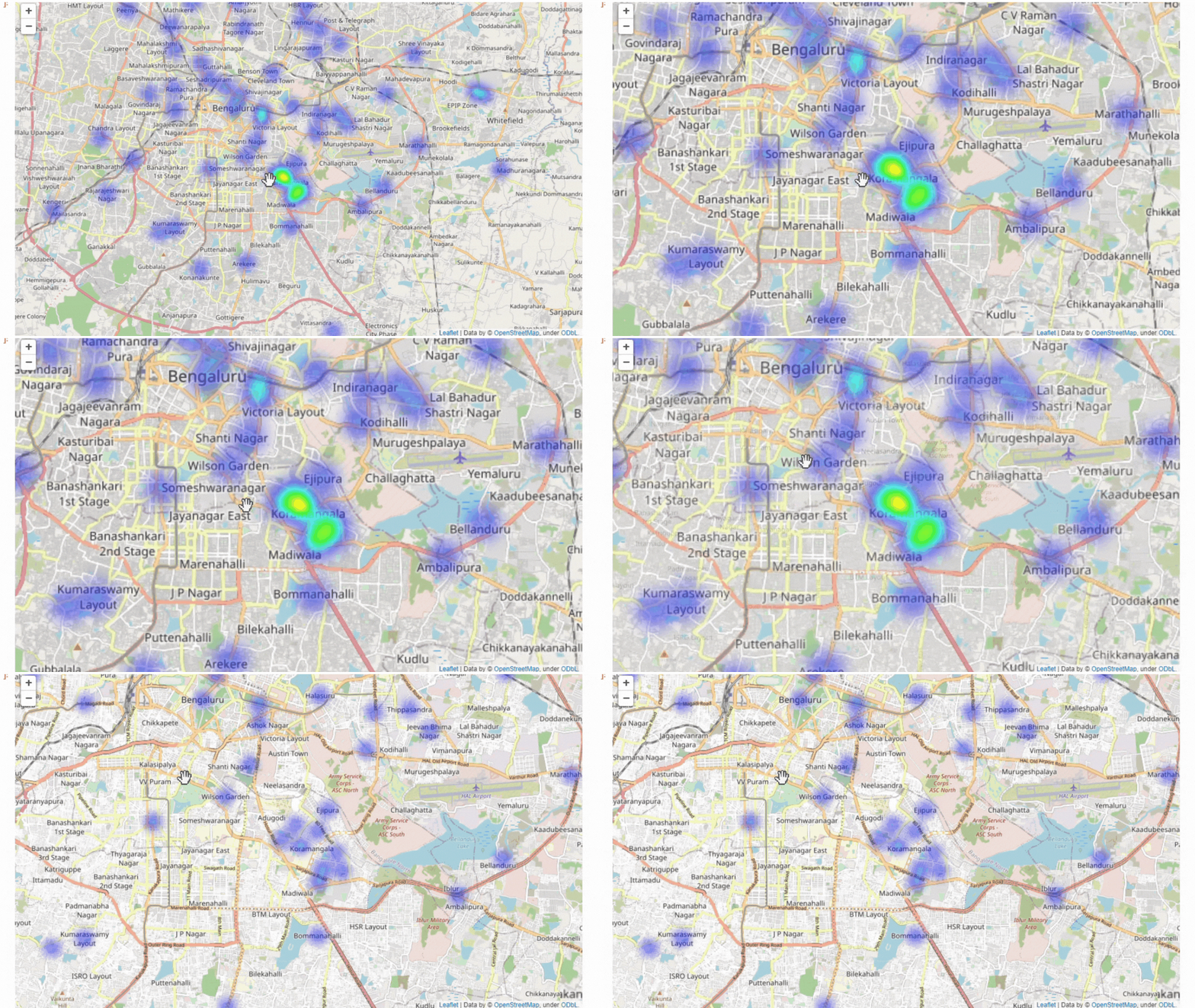
    • Plot a HeatMap based on variety of use cases with the help of Python’s Folium “HeatMap” Plugins.
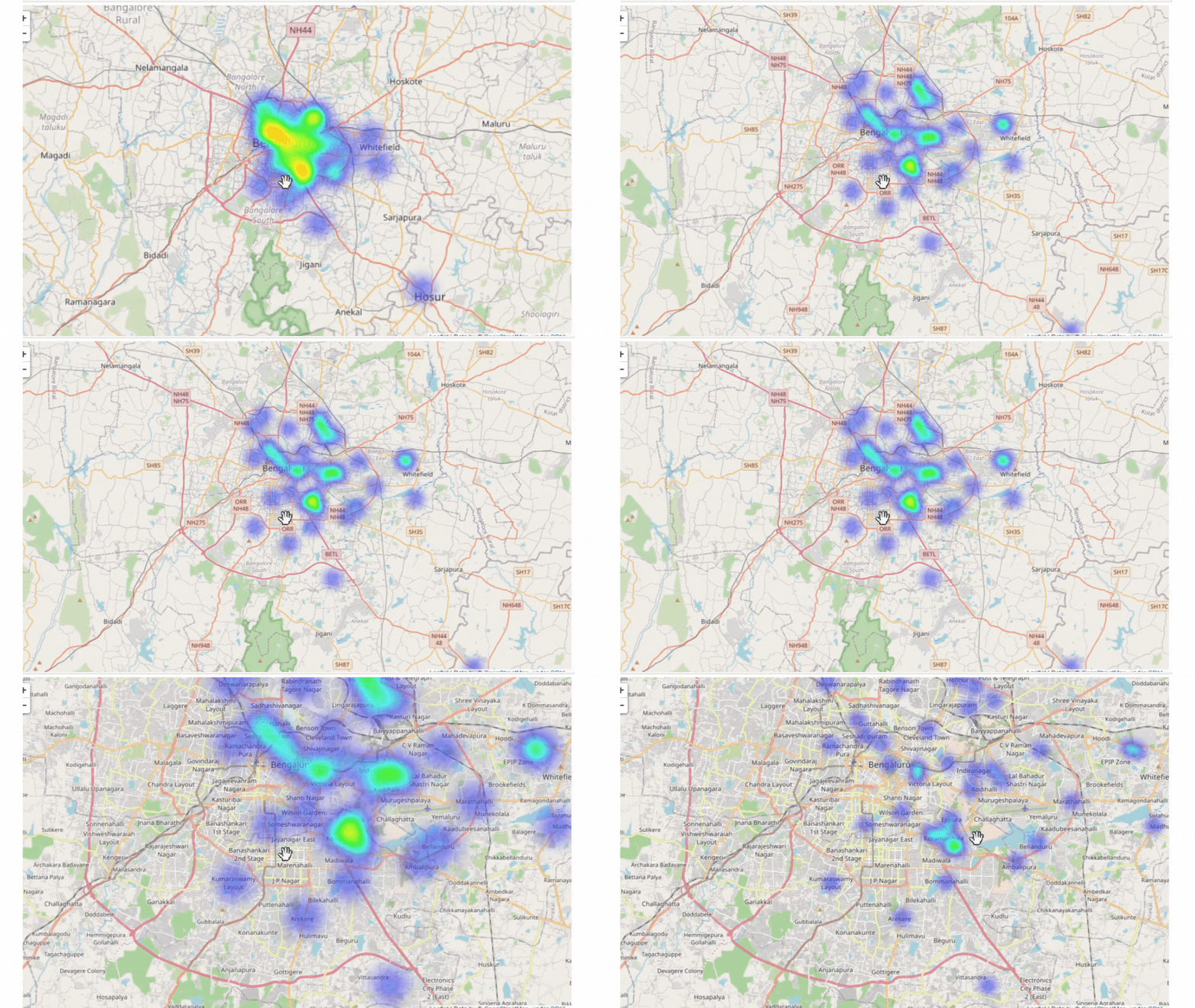
    • The heatmap below depicts the clutter of restaurants in Bengaluru.

    heatmap of blore

    Heatmap of North Indian restaurants

    hm of ni

    Sentiment Analysis

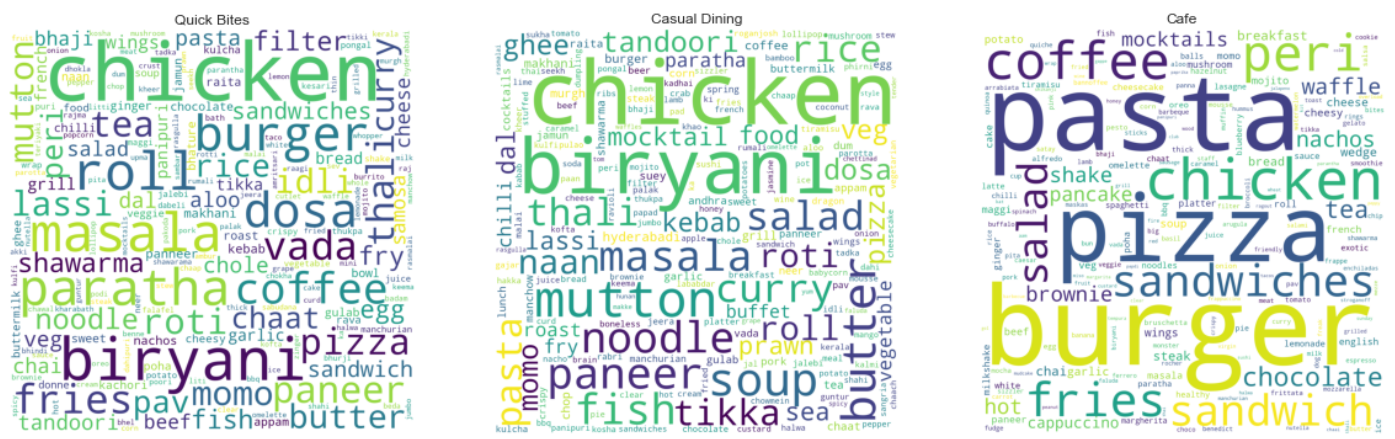
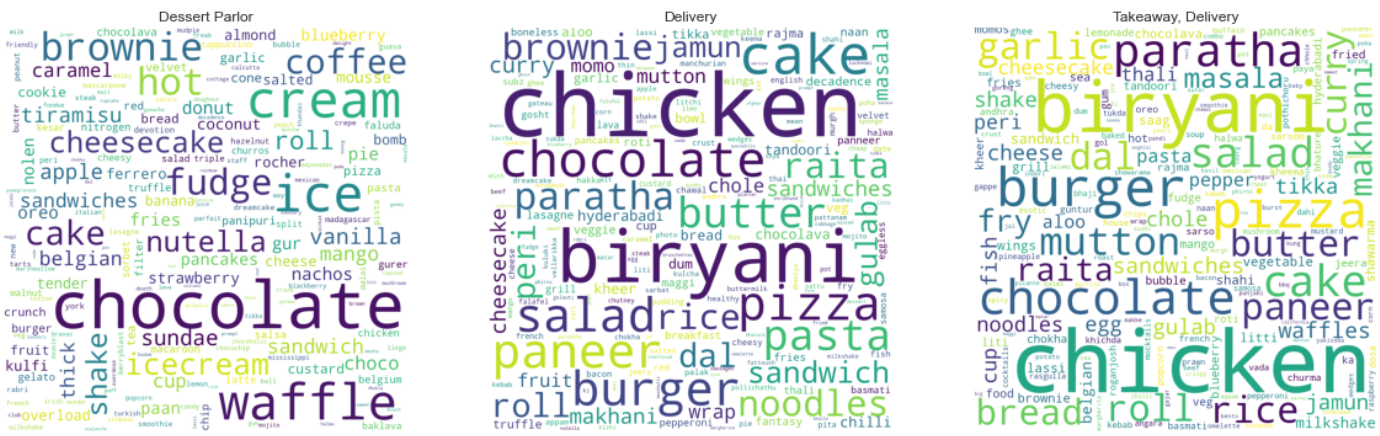
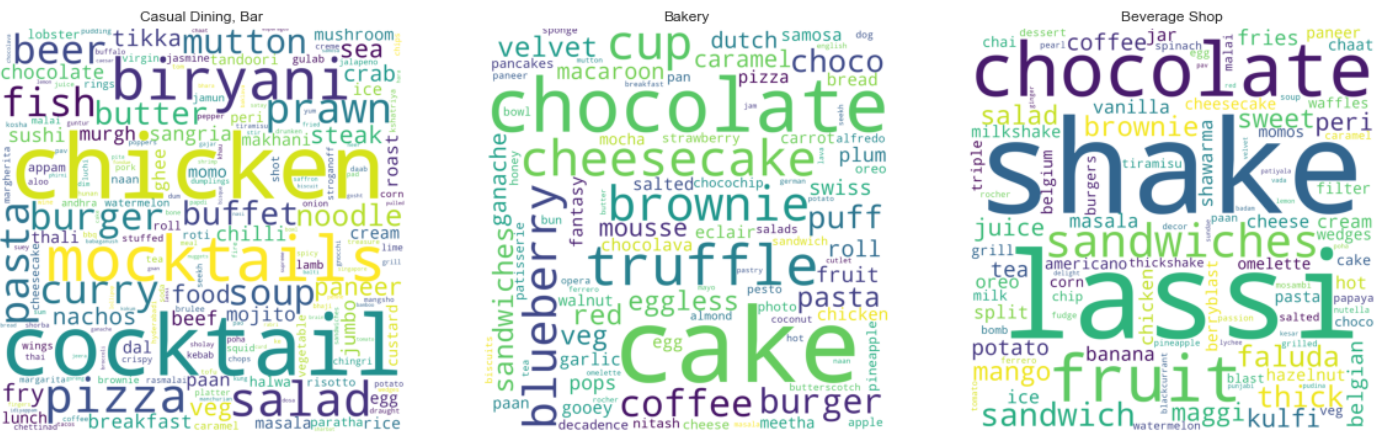
    • Here are the Wordclouds developed using the built-in function in python called “WordCloud” for 9 different types of restaurants where customers left feedback.
    • To generate the below pictured wordclouds using Python, feedbacks are preprocessed, null values are dropped and all characters and spaces are removed except alphabets.

    image

    image

    image

    Tools Used

    Jupyter Notebook Python Pandas NumPy Matplotlib Plotly

    • Jupyter Notebook is used as IDE.
    • Among the Python libraries, Pandas and NumPy are used for handling data, preprocessing, and mathematical operations, respectively.
    • Plotly, Seaborn, and Matplotlib are used for visualizing plots.

    For more details, please go through the Jupyter Notebook attached above.

    Conclusion

    • Cafe Coffee Day dominates the restaurant chain landscape followed by Onesta and then Empire.
    • Online orders are accepted by 64.4% of restaurants, whereas 35.6% of restaurants do not accept them.
    • The city of Bangalore is known as a high-tech hub of India, and people who live a busy and modern life are inclined to choose Quick Bites.
    • The most common cuisines are North Indian, Chinese, and South Indian. Bangalore is therefore influenced more by the cultures of the north than those of the south.
    • Having reviewed the above scatterplot, we can conclude that most of the highest-rated restaurants accept online orders and are budget-friendly as well.
    • In the box plot, it can be seen that there is a discrepancy between the median number of votes for both categories. The Zomato application gives customers the option to rate restaurants after they’ve ordered through it. This will lead to more votes for the restaurants accepting online orders.
    • The majority of the restaurants are priced under 1000, which means they are affordable and few are luxurious.
    • The most no. of eateries are found in BTM, HSR, and Koranmangala 5th block. BTM dominates the section by having more than 4000 restaurants.
    • It is evident that eateries are primarily located in the central Bangalore region. As we get farther from the center of the city, the number of restaurants decreases. Therefore, prospective restaurateurs can consult this to identify suitable places for their business.

    Check out the notebook above to learn more

    Visit original content creator repository
  • Encounter-Sheet-Imports

    Encounter-Sheet-Imports

    Monster Imports for Shwaffle’s D&D 5e Encounter Sheet

    File Listing:

    File Name Book Title Sub-Book Titles Monster Count
    CoS Curse of Strahd 19
    EE Elemental Evil Princes of the Apocalypse 42
    MM Monster Manual 456
    MToF Mordenkainen’s Tome of Foes 140
    RoD Rage of Dragons Out of the Abyss 35
    SKT Storm King’s Thunder 31
    TftYP Tales from the Yawning Portal 26
    ToA Tomb of Annihilation 35
    ToB Tome of Beasts 48
    ToD Tyrrany of Dragons Hoard of the Dragon Queen, Rise of Tiamat 23
    Tortle The Tortle Package 6
    VGtM Volo’s Guide to Monsters 141


    v1.62 (11/18/18)

    • Fixed issue with ‘Skills’ not showing properly
    • Added in the Constitution Modifier for the hit dice due to demand

    v1.61 (7/19/18)

    This one is all bug fixes! I highly recommend deleting all previous copies to make sure you’re using this version. I would also love to know if this alerts people when I update? Is there any other way I should be alerting people? Let me know.

    • Went through and tested all monsters so none of them should error out. Please report any oddities and bugs on GitHub
    • Changed the verbiage of two-handed variant attacks in the descriptions to make it more apparent
    • Fixed a bug where some attacks wouldn’t show based on the ability
    • Small code changes for consistency

    v1.6 (7/7/18)

    This feels like a small update due to the changelog, but I think the way I reworked how you choose a monster is such a big addition that I wanted to push it out as quickly as possible. This has been something I’ve wanted to add for quite a while so it feels nice that it’s finally finished. This is the groundwork I needed to get the different lists into the sheet so let me know what you think!

    *Added an icon for Tortle Package for fun
    *Added info on how to contact me

    v1.51 (7/2/18)

    • Fixed a typo that caused Tales from the Yawning Portal not to work.


    v1.5 (6/24/18)

    Per usual I took too long with me recent update. This is a big one so I hope it makes up for the delay in the new manuals!


    I would love to have some input from users on what they think needs to be changed or added. After submitting this file, I’m going to begin work in a single page monster sheet. This will be extremely beneficial for boss level monsters that have a large traits/actions section. After that, I would like to work on an initiative order page! That sounds like a fun challange so I hope it turns out well. I appreciate everyones support and thank you for using my sheet! You can contact me at the GitHub link below, or you can message me on Reddit @ Shwaffle.


    I have also put all of the monster information up on my Github. You can view all of the data and submit errors at: https://github.com/Shwaffle/Encounter-Sheet-Imports


    Fixes

    • Fixed the font size of Speed so it’s actually readable.
    • Encounter XP was only pulling the XP from the top monster. I am very sorry for those that relied on this and were given the wrong information.
    • Previous versions of the sheet would disable form highlighting for Adobe globally. This has been fixed to re-enable form highlighting on close.
    • Fixed a lot of errors in Monster Imports

    Additions

    • Added Tome of Beasts.
    • Added Mordenkainen’s Tome of Foes.
    • Added The Tortle Package.
    • Added radio buttons at the top to select whether or not you would like Adobe’s field highlighting. I think it looks better off, but choose what you’d like!
    • Added some nice icons for the manuals you select.


    v1.4 (2/18/18)

    Fixes

    • I really, really broke actions in 1.32 somehow. This has been fixed, and I can’t believe I hadn’t noticed earlier.
    • Fixed multiple Spellcasting blocks.
    • STR mod had a 2 character limit, which broke when monsters had anything over +9 to the mod. This has been fixed.
    • Fixed a lot of data issues that weren’t properly coded.

    Additions/Changes

    • Redid the manual selections at the top, this will allow for a lot more adaptability.
    • Manually changing the ability score now modifies saves and mods.
    • Added a bunch of tooltips!
    • Added Elemental Evil (Out of the Abyss), Tyranny of Dragons (Hoard of the Dragon Queen, Rise of Tiamat), Curse of Strahd, Storm Kings Thunder, and Yawning Portal.
    • Added a lot of missing monsters, thank you to those who have let me know!
    • Added encounter name and location at the top, suggested by users!
    • Underneath the monster’s name you can now select a checkbox to manually change the name of the monster without it killing the stats. Suggested by users!
    • Added Type & Subtype if applicable!
    • You can now search for a monster name!
      • It is case sensitive
      • Adobe DC currently has a bug that makes this feature not 100% reliable. However, being able to search in the dropdown should help a significant amount with the major manuals.

    Going to be working hard to get Tome of Beasts complete before Mordenkainen’s Tome of Foes is released in May.

    v1.32 (10/20/17)

    • Split some variants into their own monsters
    • Organized spells so they display nicer
    • Trying new Clear Form buttons
    • Traits and Actions will begin to display nicer when they have multiple paragraphs
    • Skills added
    • Rest of Monster Manual added
    • Began work on allowing DMs to have initiative rolled for the monsters. Will have both singular initiative and group initiative. (The extra radio button that pops up when you choose the monster won’t do anything for now)
    • I was doing a lot of little changes and may have forgotten to patch some holes. If you find anything that breaks the sheet let me know!

    v1.31 (7/3/17)

    • Checking the radio boxes near the HP boxes will now add monster XP to the total encounter experience
    • Passive Perception and Proficiency Bonus now have their own boxes
    • Immunities and Resistances have been moved to “Creature Info”
    • Armor Type has been added, will display a shield when the creature has one wielded
    • Top of the encounter sheet has been redone. Unavailable manuals are greyed out
    • Made the ‘Clear’ buttons a little better. I don’t like the ‘Clear Form’ one, I’m thinking of what I want to change that to
    • Fixed some traits not populating correctly from Volo’s
    • Began work on encounter difficulty

    v1.3 (5/29/2017)

    • Volo’s Guide is now an option!
    • You can choose at will which manual you want to pull your monster data from. Some traits may not show correctly, but it is mostly finished.
    • Fixed INT and CON being switched in the stats columns.
    • Added an overflow page to allow for longer descriptions to be readable.

    v1.23 (5/23/2017)

    • Creature source book and stat block page added.
    • Languages will no longer show a blank line when a creature does not have language.

    v1.22 (5/13/2017)

    • Passive Perception is now included in Creature Info. I will move this into its own stat box in a future update.

    v1.21 (5/9/2017)

    • Saving throws have been fixed. Now clears all fields when you select a new creature. Leaving CLEAR buttons for now.

    v1.2 (5/8/2017)

    • Fixed +hit issue, fixed some finesse weapons using the wrong modifier

    v1.1 (5/7/2017)

    • Initial Release

    Visit original content creator repository

  • viziquer-tools

    ViziQuer Tools

    This repository contains scripts and initial data for starting your own copy of ViziQuer Tools as a set of interlinked containers.

    This repository is an integrator module + initial data; the tools themselves come from the following repositories:

    For more information on the ViziQuer tools family, please visit viziquer.lumii.lv.

    Acknowledgement

    The repository has been developed at Institute of Mathematics and Computer Science, University of Latvia,
    with support from Latvian Science Council grant lzp-2021/1-0389 “Visual Queries in Distributed Knowledge Graphs” (2022-2024).

    Requirements

    You should have a Docker-compatible environment installed (e.g. Docker Desktop, Podman, OrbStack, …).

    Any Linux server with Docker components installed will also be sufficient, either on cloud or on-premise.

    You should have some free disk space for the data and for container images.

    Before First Start

    Download this git repository, or clone it to a local directory of your choice.

    Create a file .env as a copy of sample.env, and configure it to your preferences (ports, passwords, etc.)

    Start/Stop the Tools

    Start the Tools by issuing the commands:

    cd viziquer-tools
    docker-compose up -d

    On the first start, the required images will be pulled from registries, and the databases will be populated with starter data.

    To stop the Tools, issue the command

    cd viziquer-tools
    docker-compose down

    Note: Depending on your version of container tools, instead of docker-compose ... you may need to use docker compose ....

    Using ViziQuer Tools

    ViziQuer Tools are available via any modern Internet browser via addresses http://localhost:%port%.

    The following addresses are shown assuming you used the default ports provided in sample.env

    You can connect to the ViziQuer via http://localhost:80

    You can connect to the pgAdmin via http://localhost:9001; on first start you will be asked for the password for the rdfmeta user

    The DSS instance API is available via http://localhost:9005

    The Postgres server is available at localhost:5433

    Populating the Data

    Initially, two example schemas are included: Nobel_prizes and Starwars.

    To add a schema for another endpoint, whether public or your own, follow these two steps:

    • extract the schema from the endpoint
    • import the schema into ViziQuer Tools

    Note: it is planned to automate these steps in some of the next releases.

    Alternatively, existing schemas (e.g., created on other servers) can be uploaded.

    Extracting the schema from the endpoint

    To extract a schema from an endpoint, you should use OBIS-SchemaExtractor, version 2, and follow the instructions there.

    Importing the schema into ViziQuer Tools

    Once you have obtained a JSON file with the extracted schema, you need to import this JSON file into ViziQuer Tools.

    Currently, to import the schema, use the importer module
    from the Data Shape Server repository.

    Data schema uploading

    An existing SQL database schema script (like the ones in ./db/init/pg directory) can be executed against the database instance to create a new schema.
    Manual updates of tables schemata and endpoints in the public schema are needed to make this information accessible from the visual environment
    (auto-update of these tables is performed for schemas loaded during the fresh start (restart from scratch) of the system).

    (Re)starting from scratch

    Data from the directories ./db/init/pg and ./db/init/mongo will be imported on first start of the system.

    To restart later from scratch, remove the following directories:

    • ./db/pg to restart with a fresh DSS database content
    • ./db/mongo to restart with fresh content of ViziQuer projects database

    and then restart the Tools, as in the following commands:

    cd viziquer-tools
    docker-compose down
    rm -rf db/pg
    docker-compose up -d

    (Re)starting from scratch can be used also for auto-uploading of schema scripts created elsewhere.
    For that, place the schema scripts in the ./db/init/pg folder before the fresh start of the system
    (please prefix the script file names by a unique 2-digit number, less than 99, followed by _, as, e.g., 07_).

    Updating components

    cd viziquer-tools
    docker-compose down
    docker-compose pull
    docker-compose up -d

    Uninstalling ViziQuer Tools

    Just delete the directory ./viziquer-tools with all its subdirectories.

    Note: Don’t forget to export your project data before uninstalling ViziQuer Tools.

    Visit original content creator repository

  • react-dotenv

    react-dotenv

    Warning

    This package is deprecated and archived since create-react-app is being sunsetted.

    See: https://react.dev/blog/2025/02/14/sunsetting-create-react-app

    Load environment variables dynamically for your React applications created with create-react-app.

    This will create a env.js file in your public and build directories, which will expose your environment variables you want in the global window.env variable.
    It will also take care of configuring the index.html file present in those directories to load that file.

    Installation

    npm install @ludovicm67/react-dotenv

    Usage

    Setup your project

    Create a .env file at the root of your project, with some relevant values, like this:

    API_URL=https://example.com
    SOME_OTHER_VARIABLE=foo

    Open your project’s package.json file and add:

    • the react-dotenv command to your start and build scripts.
    • the react-dotenv.whitelist property to specify which variables you need to be exposed.

    Here is an example:

    package.json:

    {
      // …other fields
    
      "scripts": {
        "start": "react-dotenv && react-scripts start", // <-- append command
        "build": "react-dotenv && react-scripts build", // <-- append command
        "test": "react-scripts test",
        "eject": "react-scripts eject"
      },
    
      // …some other fields
    
      // Add the react-dotenv configuration
      "react-dotenv": {
        "whitelist": ["API_URL"]
      }
    }

    Access environment variables from your code

    You can start the development server using the following command:

    npm run start

    Now your project have the environment variables loaded globally in the window.env property.

    You can access the environment variables from your code in two ways:

    Using the @ludovicm67/react-dotenv library (recommended)

    import React from "react";
    import env from "@ludovicm67/react-dotenv";
    
    const MyComponent = () => {
      return <div>{env.API_URL}</div>;
    };
    
    export default MyComponent;

    Using the window.env global variable

    import React from "react";
    
    const MyComponent = () => {
      return <div>{window.env.API_URL}</div>;
    };
    
    export default MyComponent;

    Known limitations

    This only supports one environment (so only one .env file) and is not meant to do more.

    Attributions

    Forked from jeserodz/react-dotenv.

    Reasons:

    • upgrade dependencies
    • use ESM
    • fix TypeScript types
    • fix the import of the env.js file in the index.html files

    Visit original content creator repository

  • Generalized-regression-neural-networks-library-from-scratch

    Generalized Regression Neural Networks (GRNN)

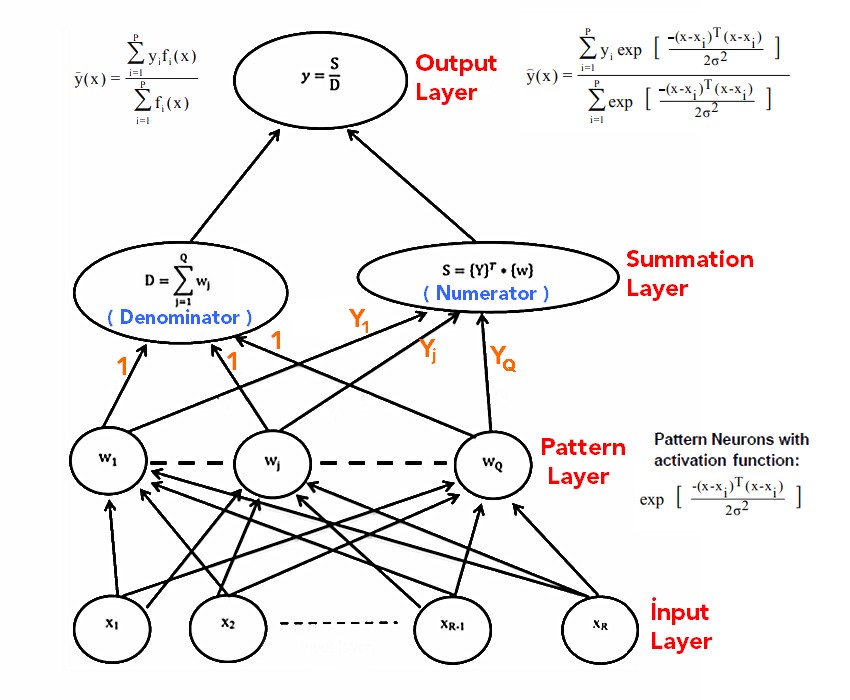
    Generalized regression neural network (GRNN) is a variation to radial basis neural networks. GRNN was suggested by D.F. Specht in 1991.GRNN can be used for regression, prediction, and classification. GRNN can also be a good solution for online dynamical systems. GRNN represents an improved technique in the neural networks based on the nonparametric regression. The idea is that every training sample will represent a mean to a radial basis neuron.[1]

    GRNN is a feed forward ANN model consisting of four layers: input layer, pattern layer, summation layer and output layer. Unlike backpropagation ANNs, iterative training is not required. Each layer in the structure consists of different numbers of neurons and the layers are connected to the next layer in turn. [2]

    • In the first layer, the input layer, the number of neurons is equal to the number of properties of the data.[3]

    • In the pattern layer, the number of neurons is equal to the number of data in the training set. In the neurons in this layer, the distances between the training data and the test data are calculated and the results are passed through the radial based function (activation function) with the σ value and the weight values are obtained.[3]

    • The summation layer has two subparts one is Numerator part and another one is Denominator part. Numerator part contains summation of the multiplication of training output data and activation function output (weight values). Denominator is the summation of all weight values. This layer feeds both the Numerator & Denominator to the next output layer.[3]

    • The output layer contains one neuron which calculate the output by dividing the numerator part of the Summation layer by the denominator part.[3]

    Algorithm-Graph

                                                   The general structure of GRNN [3]
    

    Training Procedure

    Training procedure is to find out the optimum value of σ. Best practice is that find the position where the MSE (Mean Squared Error) is minimum. First divide the whole training sample into two parts. Training sample and test sample. Apply GRNN on the test data based on training data and find out the MSE for different σ. Now find the minimum MSE and corresponding value of σ. [3]

    Advantages of GRNN

    • The main advantage of GRNN is to speed up the training process which helps the network to be trained faster.

    • The network is able to learning from the training data by “1-pass” training in a fraction of the time it takes to train standard feed forward networks.

    • The spread, Sigma (σ), is the only free parameter in the network, which often can be identified by the V-fold or Split-Sample cross validation.

    • Unlike standard feed forward networks, GRNN estimation is always able to converge to a global solution and won’t be trapped by a local minimum. [3]

    Disadvantages of GRNN

    • Its size can be huge, which would make it computationally expensive. [4]

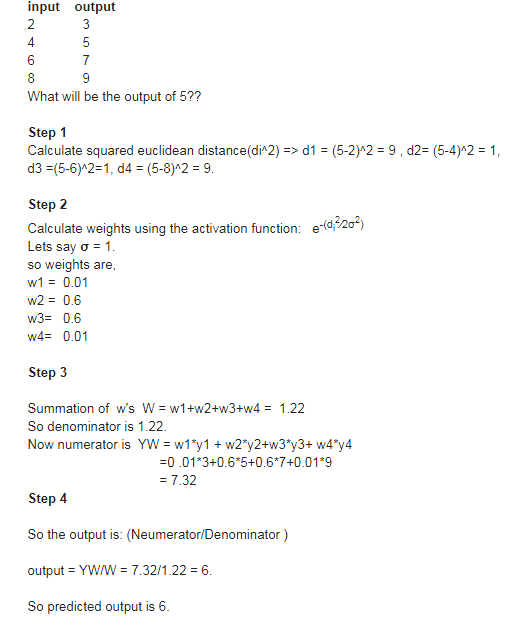
    Example

    Retrieved from [3]

    Example

    Resources

    [1] https://www.wikizeroo.org/index.php?q=aHR0cHM6Ly9lbi53aWtpcGVkaWEub3JnL3dpa2kvR2VuZXJhbF9yZWdyZXNzaW9uX25ldXJhbF9uZXR3b3Jr

    [2] https://www.journalagent.com/pajes/pdfs/PAJES_24_5_857_863.pdf

    [3] https://easyneuralnetwork.blogspot.com/2013/07/grnn-generalized-regression-neural.html

    Visit original content creator repository
  • openapi-sdk-php

    English | 简体中文

    Alibaba Cloud SDK for PHP

    Latest Stable Version composer.lock Total Downloads License codecov Travis Build Status Appveyor Build Status

    AlibabaCloud

    The Alibaba Cloud V1.0 SDK will soon enter the Basic Security Maintenance phase and is no longer recommended for use. It is suggested to use the V2.0 SDK instead.

    Release Notes

    We developed a new kernel on the principle of eliminating known issues and compatible with old grammar, adding the following features:

    Prerequisites

    Your system will need to meet the Prerequisites, including having PHP >= 5.5. We highly recommend having it compiled with the cURL extension and cURL 7.16.2+.

    Installation

    If Composer is already installed globally on your system, run the following in the base directory of your project to install Alibaba Cloud SDK for PHP as a dependency:

    composer require alibabacloud/sdk

    Please see the Installation for more detailed information about installing through Composer and other ways.

    Troubleshoot

    Troubleshoot Provide OpenAPI diagnosis service to help developers locate quickly and provide solutions for developers through RequestID or error message.

    Online Demo

    Alibaba Cloud OpenAPI Developer Portal provides the ability to call the cloud product OpenAPI online, and dynamically generate SDK Example code and quick retrieval interface, which can significantly reduce the difficulty of using the cloud API.

    Quick Examples

    Before you begin, you need to sign up for an Alibaba Cloud account and retrieve your Credentials. Before request, please Understanding the Clients, after request, please Understanding the Result.

    Currently, only some Alibaba Cloud products are supported, Supported Products, For products that are not supported, you can use Alibaba Cloud Client for PHP to initiate custom requests, and you can use Alibaba Cloud OpenAPI Developer Portal to generate Alibaba Cloud Client for PHP code online.

    <?php
    
    use AlibabaCloud\Client\AlibabaCloud;
    use AlibabaCloud\Client\Exception\ClientException;
    use AlibabaCloud\Client\Exception\ServerException;
    use AlibabaCloud\Ecs\Ecs;
    
    // Set up a global client
    AlibabaCloud::accessKeyClient('foo', 'bar')
                ->regionId('cn-hangzhou')
                ->asDefaultClient();
    
    try {
        // Access product APIs
        $request = Ecs::v20140526()->describeRegions();
        
        // Set options/parameters and execute request
        $result = $request->withResourceType('type') // API parameter
                          ->withInstanceChargeType('type') // API parameter
                          ->client('client1') // Specify the client for send
                          ->debug(true) // Enable the debug will output detailed information
                          ->connectTimeout(0.01) // Throw an exception when Connection timeout 
                          ->timeout(0.01) // Throw an exception when timeout 
                          ->request(); // Execution request
    
        // Can also Set by passing in an array
        $options = [
                       'debug'           => true,
                       'connect_timeout' => 0.01,
                       'timeout'         => 0.01,
                       'query'           => [
                           'ResourceType' => 'type',
                           'InstanceChargeType' => 'type',
                       ],
                   ];
        
        // Settings priority
        $result2 = Ecs::v20140526()
                      ->describeRegions($options)
                      ->options([
                                    'query' => [
                                        'Key'      => 'I will overwrite this value in constructor',
                                        'new'      => 'I am new value',
                                    ],
                                ])
                      ->options([
                                    'query' => [
                                        'Key' => 'I will overwrite the previous value',
                                        'bar' => 'I am new value',
                                    ],
                                ])
                      ->debug(false) // Overwrite the true of the former
                      ->request();
        
    } catch (ClientException $exception) {
        echo $exception->getMessage(). PHP_EOL;
    } catch (ServerException $exception) {
        echo $exception->getMessage() . PHP_EOL;
        echo $exception->getErrorCode(). PHP_EOL;
        echo $exception->getRequestId(). PHP_EOL;
        echo $exception->getErrorMessage(). PHP_EOL;
    }

    Issues

    Opening an Issue, Issues not conforming to the guidelines may be closed immediately.

    Changelog

    Detailed changes for each release are documented in the release notes.

    Contribution

    Please make sure to read the Contributing Guide before making a pull request.

    References

    License

    Apache-2.0

    Copyright (c) 2009-present, Alibaba Cloud All rights reserved.

    Visit original content creator repository
  • harvest_qmcpack

    master build status

    harvest_qmcpack

    Python module containing useful routines to inspect and modify qmcpack objects.

    Quick Start

    Install

    Clone the repository and add it to PYTHONPATH. To use examples, add bin to PATH.

    git clone https://github.com/Paul-St-Young/harvest_qmcpack.git ~
    export PYTHONPATH=~/harvest_qmcpack:$PYTHONPATH
    export PATH=~/harvest_qmcpack/bin:$PATH

    Prerequisites can be installed following requirement.txt

    cd ~/harvest_qmcpack; pip install --user -r requirements.txt

    You can also use pip if you do not intend to change the code

    git clone https://github.com/Paul-St-Young/harvest_qmcpack.git ~/harvest_qmcpack
    pip install --user ~/harvest_qmcpack

    To update to the newest version:

    cd ~/harvest_qmcpack
    git pull
    pip install --user --upgrade ~/harvest_qmcpack

    Tests

    Unit tests should work with either nosetest or pytest

    cd ~/harvest_qmcpack; pytest -v .

    Use

    The library functions can be used in a python script

    # extract all scalar data from a run directory 
    #  look for scalar.dat files and collect statistics
    #  hint: run dirrctory does not have to be an actual run
    import os
    from qharv.reel  import scalar_dat, mole
    from qharv.sieve import scalar_df
    """
    *** Strategy adopted in this script:
     1. use "mole" to dig up the locations of all 
      scalar.dat to be analyzed.
     2. use "reel" to reel in all scalar data 
      without prejudice.
     3. use "sieve" to remove equilibration data 
      and perform averages to shrink the database.
    only two human inputs are required: folder, nequil
    """
    
    # folder containing QMCPACK scalar.dat files
    folder = './runs'
    
    # define equilibration length and autocorrelation length
    nequil = 5
    kappa  = 1.0 # None to re-calculate
    #  runs should be designed to have short equilibration and
    # no autocorrelation. kappa can be calculated on-the-fly
    # ,be warned though: kappa calculation is slow. For nequil:
    # unfortunately I have yet to find a fast and RELIABLE
    # algorithm to determine nequil. For custom nequil, use
    # a dictionary in the `for floc in flist` loop.
    
    # generate the list of scalar.dat files to analyze
    flist = mole.files_with_regex('*scalar.dat', folder)
    
    # analyze the list of scalar.dat files
    data  = []
    for floc in flist:
      mydf = scalar_dat.parse(floc)
      mdf  = scalar_df.mean_error_scalar_df(mydf,nequil,kappa=kappa)
      assert len(mdf) == 1 # each scalar.dat should contribute only one entry
      # add metadata to identify runs
      mdf['path'] = os.path.dirname(floc)
      mdf['fdat'] = os.path.basename(floc)
      data.append(mdf)
    df = pd.concat(data).reset_index() # index must be unique for the database to be saved

    The examples in the “bin” folder can be ran in the shell

    $ stalk vmc.in.xml
    $ stab vmc.s000.scalar.dat
    $ slash-and-burn -y -v nscf
    $ rebuild_wf opt.in.xml

    Documentation

    Documentation is available on github pages.
    A local copy can be generated using sphinx (pip install --user sphinx).
    To generate the documentation, first use sphinx-apidoc to convert doc strings to rst documentation:

    cd ~/harvest_qmcpack/doc; sphinx-apidoc -o source ../qharv

    Next, use the generated Makefile to create html documentation:

    cd ~/harvest_qmcpack/doc; make html

    Finally, use your favorite browser to view the documentation:

    cd ~/harvest_qmcpack/doc/build; firefox index.html

    Examples

    Example usage of the qharv library are included in the “harvest_qmcpack/bin” folder.
    Each file in the folder is a Python script that performs a very specific task:

    • stalk: Show crystal structure specified in a QMCPACK input e.g. stalk vmc.in.xml
    • stab: Scalar TABle (stab) analyzer, analyze one column of a scalar table file, e.g. stab vmc.s000.scalar.dat
    • transplant: Backup nexus-generated folders. Allow user to select subfolders to backup. e.g. transplant graphene attic -s opt -s qmc -e will backup the QMC runs in folder “opt” and “qmc” from graphene/results and graphene/runs to attic/graphene/results and attic/graphene/runs. The “scf” and “nscf” folders will not be backed up.
    • slash-and-burn: Remove temporary files generated by Quantum Espresso.
    • rebuild_wf: Rerun QMCPACK on optimized wavefunctions, e.g. rebuild_wf opt.xml

    Description

    This module is intended to speed up on-the-fly setup, run, and analysis of QMCPACK calculations.
    The module should be used as a collection of python equivalents of bash commands.
    This module is NOT intended to be a full-fledged workflow tool.
    Please refer to nexus for complete workflow magnagement.

    Development Guidelines

    sown the seeds, inspect the crop;
    crossbreed to improve, transplant to adapt;
    reel them in, sieve for good, and refine for the best.
    — qharv maxim

    Laws of Programming (fully plagiarized from Asimov)

    1. A program may not produce wrong results or, through inaction, allow a user to produce wrong results.
    2. A program must accept manual overrides given to it by a user, except where such overrides will conflict with the First Law.
    3. A program must be as simple and as readable as possible, as long as doing so does not conflict with the First or the Second Law.

    note: the simplest way to satisfy both the First and the Second Law is to abort at an unknown request.

    Visit original content creator repository